Mostrando entradas con la etiqueta Speaking activities. Mostrar todas las entradas

sábado, 25 de abril de 2015

Conversation & interaction situations

http://www.embassyenglish.com/-/media/Embassy/Images/Courses/Business_English_Power_Speaking_English_Course_2.jpg?h=420&w=689

This link shows many conversation & interaction situations. Very useful!

http://www.eslgold.com/speaking/phrases.html

Picture description (monologue)

In the beginning it can seem very difficult to describe and interpret pictures. But after you learn a step-by-step formula for looking and talking about the picture it becomes very easy. The guidelines below can be used to describe any picture and the steps can be memorised. You will never run out of things to say about a picture again. {Some of the following information was sourced from: www.studymode.com}

Analysing the picture

1)  Introduction (i) Give a general overview of what the picture is about (WHERE + WHAT) (ii) “This picture was probably taken at _________. It shows ________.” 2)  Description / Interpretation (i)  Be organised and systematic. Focus on the most important part of the picture first and move around the picture. (a)  “The central focus of this picture is….” (b)  “In the foreground / middleground / background…” (c)  “On the left / right of the picture…” (d)  “In the top left corner / bottom right corner of the picture, a man…” (ii)  Use a wide and suitable range of vocabulary. Age – infant, toddler, pre-school boy/girl, young boy/girl, teenage boy/girl, young man/woman, yuppie-looking man/lady, middle-aged man/woman, elderly man/woman Facial expressions - Sad: insipid, sombre, glum, sullen, downcast Lifeliness: animated, beaming, wide-eyed – Happy smiles: bel air, graceful, gleeful, smiling like a Cheshire cat – Shy smiles: coy, demure, pinched – Laughter: hearty, bubbly, hilarious, convulsing with glee Briefly describe the clothes and hairstyle of the characters (iii)  Interpretation of People What do the facial expression and body language of a character tell you about: a.      how he is feeling or thinking? b.      what he intends to do? c.      his relationship with the others in the picture? (iv)  Interpretation of Place and Objects What kind of place is this? Why are the people there? What do the objects tell you about a.      what had happened earlier? b.      what is happening now? c.      what will happen later? d.      the weather and the time of the day? What is the atmosphere? Happy ? busy? Calm? Exciting? Boring? (v)      Interpretation – Some useful structures “From her facial expression, I can assume that…” “From the wrappers on the floor, I can tell that…” “I believe…” “Perhaps this man is about to…”

Perspectives

picture, image foreground indoors
painting background outdoors
photograph / photo in the upper part artificial light
portrait in the lower part subdued light
landscape painting in the left part loud colours
worm’s eye view in the right part daylight
bird’s eye view in the central part at night
in front of on the right in the evening
behind on the left light colours
next to … in the middle dark colours
from above from below high contrast colours

Describing the scene

The picture was taken in … (place). The photo was taken at … (party). The picture shows a scene from … It’s an image of … (place, person, scene). The picture describes … (scene). The picture shows … (place, person, scene) from a distance. … (place, person, scene) is shown from … (a bird’s eye view/…). You look at … (place, person, scene) from … (above/behind/…). What can you see? In the picture you can see … … (position: on the left/right/…) there is / are … … (position: on the left/right/…) you can see … … is … (position: on the left/right/…)
[stextbox id=”pin”]

Practice websites

For more practice describing pictures visit these 2 excellent websites.
www.writefix.com, it is an excellent website.  Click on the ‘PET speaking’ on the top  menu bar. Choose a picture from the menu and and try to describe it, then click on the example description to read and compare with your answer.
www.autoenglish.org is another excellent website.  Click on the left menu – Part2 / Key phrases / Example descriptions / Gallery 1 & 2.
[/stextbox]
The following descriptions were sourced from: www.writefix.com

Picture 1

astronautsThe picture shows three astronauts waiting for takeoff. The astronauts are wearing bright orange uniforms or flight suits. Two of them have US flags on their shoulders so they must be American, but I can’t see where the other one is from. The astronaut nearest the camera looks nervous. I think he is worried or anxious about the flight. Maybe he is thinking about what he has to do on this mission, or maybe he is thinking about his family. Behind him there is a scientist or an official. They could be waiting for the space shuttle to get ready, or perhaps there is a problem with the weather and their lift-off has been delayed.

Picture 2

oldladiesThis is a funny picture. It shows three old ladies picking apples in an orchard or a garden. They are having a good old time! One of the ladies is high up on a ladder, picking the apples at the top of the tree. Her hair is still dark, so I think she is the youngest of the three. The other two are on the ground. One lady, the oldest, is holding a bucket or a pail full of red apples. The other woman is also wearing a hat, so it must be hot. The three of them are smiling at the camera. I don’t know who is taking the picture, but perhaps it is someone in their family. I think after they are finished they will use the apples for baking or cooking.
Sometimes you might need to critically describe a historical painting. The information below will help you do that.

Information on artist and year of origin

… (image) is a painting by … (artist), painted in … (year). … (image), painted in … (year), is a work by … (artist) … (artist) painted … (image) in … (year). … (image) is a famous painting by … (artist).

Impression

… gives the impression of depth. … (person) seems to look at the viewer. His / Her eyes seem to follow the viewer. The figures look as if they exist in three dimensions. The viewer has the impression that the people in the picture are alive. The viewer’s attention is focused on … To the alert eye it will become apparent … The viewer finds it difficult to withdraw his eyes from … The painting is vivid / happy / expressive. The picture makes the viewer feel … (sad/happy) The picture inspires the viewer to think about …

Intention

The artist mainly uses … (colours/forms/…) Important elements are highlighted. The artist / photographer / painter uses … to express … He / She (probably) wants to criticise / express / show … It is obvious that the artist wants to criticise / express / show … What the artist / photographer / painter wants to criticise / express / show is … What the artist / photographer / painter wants to point out is … I think / believe / am sure that … It seems / appears to me that … The problem illustrated here is … … symbolises … … is typical of …

Source:  http://www.jigglish.com/listening-questions-and-answers/how-to-describe-pictures-clearly-english-speaking-tests/

jueves, 12 de marzo de 2015

Interesting videos on picture description & interaction

Here you are a couple of videos which worth a visit to check some useful expressions when discussing a topic and when describing & comparing pictures.

Describing & comparing pictures


Some ideas on carrying out conversations:

viernes, 6 de marzo de 2015

Most common mistakes in English by Spanish speakers


 https://blogger.googleusercontent.com/img/b/R29vZ2xl/AVvXsEgTgfvf4Utqdvxr-3vLMf7eHhp1dKNAT3m-ZvQCKPgnEhd-FaoeP8ZFLHs_mFunPrGKXUkcMIP1MqkOl4GDEomsO5ulkmcPtL9SyCmwTvdi6NlZViGmQA-VIOLE5O3_pA7jI631PsBTjc3_/s1600/error.png
Even we understand erros as a necessary part of the learning process of language earners, here you are a couple of links that show of the most common mistakes Spanish speakers make in English (levels A2/B1):


http://www.englishcurrent.com/grammar/common-english-mistakes-quiz/

http://www.slideshare.net/iclaudius/common-mistakes

Furthermore, here you'll find a list with common mistakes. You can check your ansers by getting to the answer key below.

All the sentences contain common mistakes. Put in the correct sentences. Use uncontracted forms

EXAMPLE

– Listen!  The birds sing.– INCORRECT: Listen the birds are singing

1.  My train is leaving at 9.15 every morning. 
2. I’m working here since July.
3. We have gone to the theatre yesterday.

4. When I was a child I was loving ice cream.
5. They are not believing us. 
6. We’ll call you when we will get to the airport. 
7. Mayumi is born in Tokyo.
8. Sergey has 25 years. 
9. Do you have hot in that sweater? 
10. He can to speak four languages. 
11. Do you want speak to me?
12. I don’t want go to work today.
13. He sat in the meeting without to speak.
14. I went to the post office for buy stamps.
15. They told to me to leave.
16. I must go to the hospital yesterday.  
17. Where we can change our money?
18. Are ready the children to leave?
19. I’m no tired. 
20. Where is post office?
21. He smiled, but he didn’t say nothing.
22. They all speak English very good. 
23. My sister is doctor.
24. I’m thirsty. Is a bottle of water in the fridge? 
25. Do I must show my passport?
26. Will you like a sandwich?
27. Nobody know where she is.
28. He’s got very loud voice.
29. Most of people like her. 
30. It’s tallest building in the world.
31. Kim plays the piano very better than Henry.
32. When I saw Sue, I gave the present to herself.
33. The life is expensive in London.
34. Sorry, I haven’t got some time.
35. It is more hot today. 
36. This room is too much cold.
37. The woman which helped me is there.
38. The police is looking for him.
39. It’s nice be here with my friends.
40. Eat fruit is good for you.
41. Please listen me carefully.
42. We went at the café yesterday afternoon.
43. I don’t like very much flying.
44. This juice isn’t enough cold.
45. Please give to me your email address.
46 I worked during three hours last night.
47. I will arrive on time if I will leave home now.
48. I don’t believe anything what he says.
49. I asked her what was her address.
50. This coffee isn’t very strong, isn’t it?

ANSWER KEY


1 My train leaves at 9.15 every morning.

2 I’ve been working here since July.
3 We went to the theatre yesterday.
4 When I was a child I loved ice cream.
5 They don’t believe us.
6 We’ll call you when we will get to the airport.
7 Mayumi was born in Tokyo.
8 Sergey is 25. (OR … is 25 years old).
9 Are you hot in that sweater?
10 He can speak four languages.
11 Do you want to speak to me?
12 I don’t want to go to work today.
13 He sat in the meeting without speaking.
14 I went to the post office to buy stamps.
15 They told to me to leave.
16 I had to go to the hospital yesterday. [
17 Where can we change our money?
18 Are the children ready to leave?
19 I’m not tired.
20 Where is the post office?
21 He smiled, but he didn’t say anything.
22 They all speak English very well.
23 My sister is a doctor.
24 I’m thirsty. Is there a bottle of water in the fridge?
25 Must I show my passport? (OR Do I have to …)
26 Would you like a sandwich?
27 Nobody knows where she is.
28 He’s got a very loud voice.
29 Most of people like her.
30 It’s the tallest building in the world.
31 Kim plays the piano much better than Henry.
32 When I saw Sue, I gave the present to her.
33 The Life is expensive in London.
34 Sorry, I haven’t got any time.
35 It is hotter today.
36 This room is too much cold. (OR … much too cold)
37 The woman who helped me is there.
38 The police are looking for him.
39 It’s nice to be here with my friends.
40 Eating fruit is good for you.
41 Please listen to me carefully.
42 We went to the café yesterday afternoon.
43 I don’t like flying very much.
44 This juice isn’t cold enough.
45 Please give to me your email address. (OR … give your email address to me)
46 I worked for three hours last night.
47 I will arrive on time if I will leave home now.
48 I don’t believe anything that he says.
49 I asked her what her address was.
50 This coffee isn’t very strong, is it?


lunes, 2 de marzo de 2015

Tips to pass the oral test

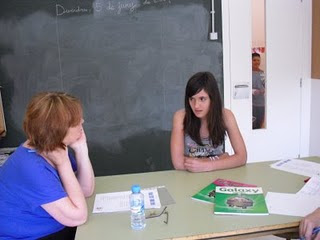
You'll find some tips on how to pass the oral test below (Catalan version).

https://blogger.googleusercontent.com/img/b/R29vZ2xl/AVvXsEiksSDkqka6CZUlGe1nv8EyWE61OZMpp7ehOgFAspOQnAqGKZ6wJ4KwNwDmq57snNZYlOpaHFk7lb4uA4epxOWVmC6lm1NdZoYzmFJAtHSRnRnGGhcl5wtzAuxXqqKhPtzLv-DqMI5_8qY/s320/CIMG0327.JPG


La prova d’expressió oral es realitzarà de mode individual i serà monitoritzada en tot moment per membres del tribunal creat a l’EOI a l’efecte. Per tant, la interacció es realitzarà sempre amb els examinadors. En aquest sentit, el procés avaluador sol tenir una durada mitjana d’uns 5 a 7 minuts, dividits en les dues següents parts:
La prova es durà a terme de forma individual.
Abans de començar la prova, l’examinand ha de triar dos temes a l’atzar. Disposarà d’uns segons per decidir quin tema vol desenvolupar i després d’un màxim de 5 min per a la preparació de la prova.
La prova oral inclou 2 parts diferenciades: una en la qual l’examinand ha de contestar les preguntes, i una altra de monòleg. Els examinadors poden iniciar la prova amb preguntes dirigides al candidat per valorar la seva capacitat espontània d’interacció social
PRIMERA PART (interacció)
S’inclouen unes fotos acompanyades d’un màxim de 6 preguntes. L’examinand ha de contestar les preguntes.
SEGONA PART (monòleg)
El candidat ha de descriure i comparar les fotografies lliurement, sense el suport de preguntes i relacionar-les amb el tema general.
- Descripció d’una o dues fotografies. Es valorarà el mode en que l’alumne analitza els conceptes inclosos empleant el vocabulari corresponent al nivell (ex. Education –high school, degree…-), i els relaciona amb el tema de mode general.
- Resposta a preguntes: El candidat ha de respondre una sèrie de preguntes que tracten sobre diferents temes de la vida quotidiana (ex. Where do you live? Do you like your town?), totes elles referides als temes curriculars. Aquestes preguntes no van acompanyades de fotos ni d’altres suports gràfics, i no tenen perquè estar relacionades amb el tema referit a la descripció o a les altres preguntes.

Criteris d’avaluació:
Fluïdesa: La capacitat de l’alumne per produir un discurs oral adequat al nivell corresponent que sigui coherent amb la tasca i la situació comunicativa. L’examinand s’ha de fer entendre amb expressions molt breus, tot i havent-hi pauses, dubtes inicials i reformulació. S’espera l’ús de connectors senzills com but and because i la utilització de frases fetes i assajades (ex. How are you today? I’m fine, and you?).

Correcció: L’ús de les estructures gramaticals i sintàctiques ha de mostrar un grau de correcció adient als requisits del nivell. S’ha de valorar també l’esforç que fa l’alumne de fer servir estructures complexes de manera ambiciosa, encara que cometi errors.

Vocabulari i riquesa d’estructures: La varietat i precisió en l’ús del lèxic i la varietat en l’ús de les estructures corresponents a cada nivell de manera que el desenvolupament de la tasca no es vegi limitat per la manca dels coneixements lèxics necessaris, els quals inclouen principalment la capacitat per a parafrasejar eficaçment en front de les dificultats de producció.

Pronunciació: Els intercanvis comunicatius s’ha de produir de manera que l’interlocutor no tingui dificultats per entendre a l’alumne. En aquest nivell s’espera que l’alumne sàpiga pronunciar les paraules individuals de mode que siguin intel·ligibles per a un parlant de llengua anglesa nadiu. No s’esperen trets de pronunciació òptims a nivell d’entonació i de pronunciació natural del discurs.

Resposta Interactiva: La capacitat de interactuar amb altres interlocutors, mostrant un repertori d’estratègies comunicatives adequades al nivell. Així, l’examinand haurà de saber contestar preguntes i respondre a afirmacions senzilles, indicant quan comprèn una conversa.

Recomanacions:
  1. A la primera part, utilitzar elements bàsics de descripció (there is/are, I can see), per ordre de rellevància (de més a manco rellevant) o topogràfic (en funció de la seva distribució a la foto), per després passar a una opinió personal.
  2. A la segona, respondre les preguntes intentant que la comunicació es mantengui almenys durant algunes frases. És a dir, a la pregunta “What do you do in your free time?”, no s’esperaria “I play tennis”, sinó una resposta de l’estil “I love doing things in my free time. I like going to the cinema with my friends. Especially to see horror films. Mmmmm... and, on Fridays I play tennis and on Saturdays I watch T.V.” 
  3. Fer servir la imaginació. Si heu de parlar de la vostra vida i trobau que no teniu res a dir, una mica de “creativitat” va bé; així podreu fer servir més vocabulari i estructures.